
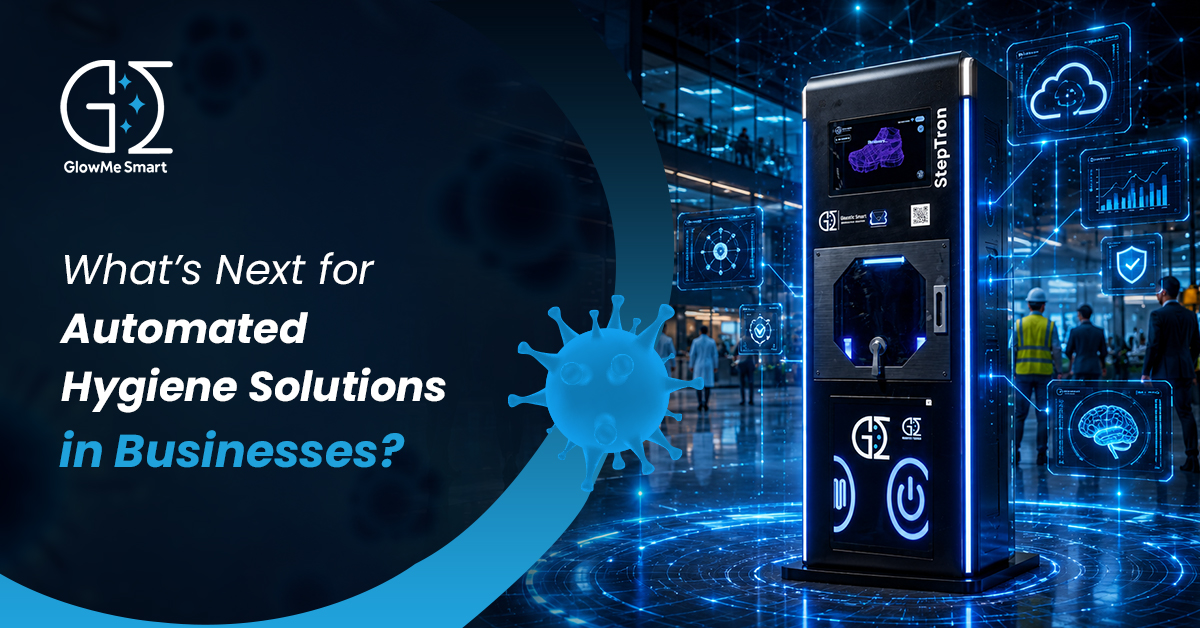
Future hygiene technology is no longer a concept businesses are preparing for. It is already being deployed across gyms, hospitals, corporate offices, and commercial facilities that have moved past reactive cleaning schedules and into proactive, automated hygiene infrastructure. The question for facility managers and business owners today is not whether automation is coming to hygiene operations. It is how quickly their current setup falls behind the facilities that have already made the shift. GlowMe Smart has been at the centre of this shift in India, building hygiene kiosks that run autonomously, log every cycle, and deliver consistent results without depending on staff availability or manual protocols.
What Are Automated Hygiene Solutions?
Automated hygiene solutions are technology-driven disinfection systems that operate without staff involvement, delivering consistent, logged hygiene outcomes at commercial entry points. Unlike manual protocols, these systems run identically every cycle, process shoes, helmets, and personal belongings automatically, and provide audit-ready data for compliance, making them a permanent infrastructure investment rather than a periodic cleaning task.
What Is Driving the Shift Toward Hygiene Automation in Commercial Spaces?
The move toward hygiene automation is not driven by technology alone. It is driven by the consistent failure of manual hygiene systems to deliver reliable outcomes at a commercial scale. Staff-dependent sanitisation protocols produce different results depending on who is running them, how busy the facility is, and how closely the process is being supervised on any given day.
GlowMe Smart recognised this gap early and built its product range around the principle that a hygiene system should perform identically for the first person through the door as it does for the last, regardless of time, staffing levels, or footfall volume.
What is accelerating hygiene automation adoption across Indian businesses:
- Consistency demand: Facilities operating under quality accreditations or hygiene audits require documented, repeatable outcomes that manual processes cannot reliably produce.
- Staff cost pressure: Automating hygiene at entry points removes the supervision and labour cost attached to manual sanitisation protocols without reducing hygiene outcomes.
- Visitor expectations: Guests, patients, and employees now expect visible, professional hygiene infrastructure as a baseline standard rather than a premium feature.
- Compliance tightening: Regulatory hygiene requirements across healthcare, hospitality, and food processing are becoming more specific and harder to meet with informal manual systems.
- IoT integration: Connected hygiene systems provide real-time usage data and cycle logs that facility managers can access remotely, reducing the operational burden of oversight.
What Are the Biggest Hygiene Automation Trends Shaping Businesses Right Now?
The hygiene automation trends reshaping commercial facilities in India and globally share a common direction: moving disinfection from a scheduled task performed by staff into a continuous, infrastructure-level function that operates independently. GlowMe Smart’s kiosk range reflects this direction precisely, with units that run full disinfection cycles for shoes, helmets, and personal belongings without requiring any human involvement at any stage.
The trends currently defining where automated hygiene is heading:
- Entry-point automation: Disinfection is moving to the threshold of every facility, intercepting contamination before it enters rather than managing it after it spreads indoors.
- Multi-technology cycles: Single-method disinfection is being replaced by combined UV-C, ozone, and steam cycles that address pathogens, fungi, and odour in one automated sequence.
- Touchless payment integration: Hygiene kiosks are now revenue-generating assets with contactless UPI, card, and digital wallet payment built directly into the cycle management system.
- Remote monitoring capability: IoT-connected units allow facility managers to track usage, cycle counts, and performance data from any location without being physically present.
- Modular deployment: Units designed for different item categories, from shoes to helmets to personal belongings, can be combined or configured to match the specific contamination profile of each venue.
Benefits of Automated Hygiene Systems in Workplaces
The benefits of automated hygiene systems in workplaces extend well beyond cleaner surfaces. When contamination is intercepted at entry, and every disinfection cycle is logged automatically, the operational, financial, and reputational impact on a business compounds over time in ways that manual hygiene programmes simply cannot replicate.
GlowMe Smart’s deployments across corporate offices, hospitals, gyms, and hospitality venues consistently demonstrate the same pattern: once automated hygiene infrastructure is in place, facilities reduce cleaning frequency, improve compliance records, and lift the visible hygiene standard that every visitor registers on arrival.
Workplace benefits of shifting to automated hygiene systems:
- Reduced floor cleaning load: Intercepting contamination at entry directly reduces the volume of bacteria and debris reaching indoor flooring throughout the day.
- Documented compliance records: Every automated cycle is logged with a timestamp and session data, providing the audit trail that accreditation and regulatory processes require.
- Lower long-term operating cost: Removing consumable mats, manual spray protocols, and supervision time reduces the recurring cost of entry hygiene over the full operational lifespan.
- Employee health protection: Staff who enter through an automated disinfection point carry less external contamination into workspaces, reducing cross-contamination between colleagues.
- Facility reputation signal: A visible, professional hygiene system at entry communicates immediately to every visitor that the standards inside the building are actively maintained.
How Is Smart Disinfection Technology Changing the Way Facilities Operate?
Smart disinfection technology trends are converging around one outcome: hygiene systems that think, log, and adapt without requiring human management at the operational level. GlowMe Smart’s kiosks are CE-certified, IoT-connected, and built to deliver the same four-stage disinfection cycle- sterilisation, disinfection, deodorisation, and complete drying – at scale without performance degradation over time.
| Criteria | Manual Hygiene Methods | Smart Disinfection Technology |
| Consistency per cycle | Variable, staff-dependent | Identical result every cycle |
| Cycle documentation | Manual log or none | Automated IoT timestamp per session |
| Staff requirement | High, ongoing | Zero at the point of operation |
| Odour elimination | Fragrance masking only | Molecular elimination via ozone |
| Compliance readiness | Difficult to document | Audit-ready data available remotely |
| Revenue generation | None | Pay-per-use model built in |
| Installation requirement | Variable | Standard power connection only |
The gap between manual and automated is not marginal. It is the difference between a hygiene system that depends entirely on human reliability and one that performs regardless of who is on shift, how busy the facility is, or what time of day it is.
Why Is UV-C the Core of Every GlowMe Smart Hygiene Kiosk?
UV-C is fast, chemical-free, and material-safe, making it the foundation of every GlowMe Smart disinfection cycle across StepTron, HelmetTron, and Personal Belongings kiosks.
Why UV-C leads modern hygiene kiosk technology:
- No chemical residue: UV-C leaves no surface contamination, keeping treated items safe for direct contact in any environment.
- Material compatibility: Leather, rubber, foam, and synthetics exit every GlowMe Smart cycle completely undamaged.
- Commercial speed: Cycles complete fast enough to handle peak footfall without queues or disruption at entry.
- Logged verification: Every UV-C cycle is recorded automatically, delivering audit-ready compliance data on demand.
GlowMe Smart pairs UV-C with ozone and steam to reach contamination layers that UV-C alone cannot, making it the strongest foundation for future-ready hygiene infrastructure.
GlowMe Smart’s automated hygiene kiosks are built to run independently, log every cycle, and protect your facility from day one. Deploy now.
FAQs
1. What is future hygiene technology for businesses?
Future hygiene technology refers to automated, IoT-connected disinfection systems that operate without staff involvement and deliver consistent, logged hygiene outcomes at a commercial scale.
2. What are the main hygiene automation trends in 2026?
Key trends include entry-point disinfection kiosks, multi-technology UV-C and ozone cycles, IoT cycle logging, touchless payment integration, and modular deployment across different venue types.
3. What are the benefits of automated hygiene systems in workplaces?
Automated systems deliver consistent disinfection, reduce staff dependency, lower long-term costs, provide compliance documentation, and signal professional hygiene standards to every visitor entering the facility.
4. How does smart disinfection technology work in a commercial kiosk?
Smart disinfection kiosks like GlowMe Smart’s StepTron run automated UV-C, ozone, and steam cycles, log every session via IoT connectivity, and operate without any staff involvement at the point of use.
5. What office hygiene solutions work best for high-footfall workplaces?
Entry-point shoe disinfection kiosks, personal item sanitising units, and IoT-logged disinfection infrastructure deliver the most consistent and documentable hygiene outcomes for busy office environments.
6. Is UV disinfection technology safe for all materials?
Yes. UV-C disinfection leaves no chemical residue and does not degrade leather, rubber, synthetic fabrics, or electronics, making it suitable for the full range of items processed in commercial hygiene kiosks.
7. How does GlowMe Smart support businesses moving toward hygiene automation?
GlowMe Smart provides CE-certified, IoT-connected hygiene kiosks for shoes, helmets, and personal belongings that install on a standard power connection and operate fully automatically from day one.